
2006-11-30















2006-08-16
The Evolution of Desktops: from 1984 to the present
A couple of days ago I did a little experiment with the previous (and first!) entry of this blog with the objective of collecting some statistical information about people like me, who are avid readers of nerdly news, and in particular of trying to measure the famous slashdot effect and compare it with its analogous from other sites. The blog entry made its way to the front page of Slashdot, Digg and their spanish clones: Barrapunto and Meneame, generating around 140,000 combined visits that were logged using Google Analytics. This time I want to share the results with you.
Duration
The article was on Slashdot's front page for about 20.5 hours (from August 13th, 2:30PM until August 14th, 11:00AM). As you can see below, most of the visits took place on monday morning. After leaving the front page of Slashdot and Digg the daily visits were reduced from 81,300 to 17,000 and surely will continue dropping as fast as they grew.| Sunday | Monday | 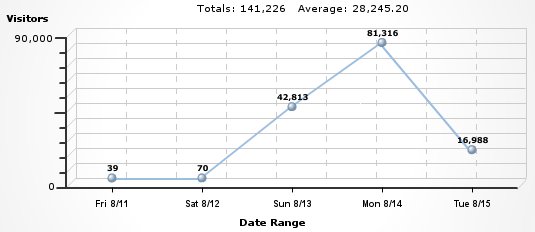 | |
| Visits: | 42,813 | 81,316 | |
| Visits/hour: | 4,505 | 7,390 | |
| Visits/minute: | 75 | 123 |
Bandwidth
A first visit to the page produce a transfer of arround 720kB, with that and the number of new visitors can we figure out how much data (approximately) was transferred during that time. | |
| Sunday: | 28.7GB |
| Monday: | 54,6GB |
| Total: | 83.3GB |
Where do all those geeks come from?
People came from all over the world, in fact from 157 different countries. Most stories in Slashdot/Digg reach every corner of the world! | |
| North America: | 77,634 visits |
| Europe: | 41,159 visits |
| Oceania: | 6,443 visits |
| Asia: | 5,423 visits |
| Hispanic America: | 5,350 visits |
| Africa: | 724 visits |
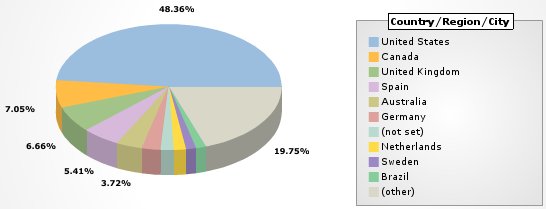 | |
| USA: | 67,752 visits |
| Canada: | 9,882 visits |
| UK: | 9,336 visits |
| Spain: | 7,577 visits |
| Australia: | 5,209 visits |
| Germany: | 3,770 visits |
| Netherlands: | 2,413 visits |
| Sweden: | 2,014 visits |
| Brazil: | 2,008 visits |
Languages
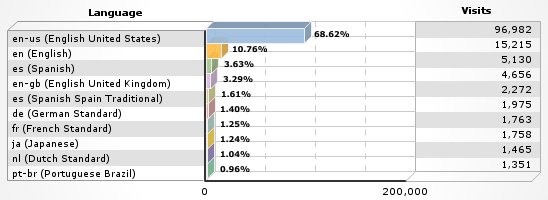 | |
| English: | 116,853 visits |
| Spanish: | 7,402 visits |
| German: | 1,975 visits |
| French: | 1,763 visits |
| Japanese: | 1,758 visits |
| Dutch: | 1,465 visits |
| Portuguese: | 1,351 visits |
The Referrers
I didn't imagine such big difference between the traffic from Slashdot and from Digg.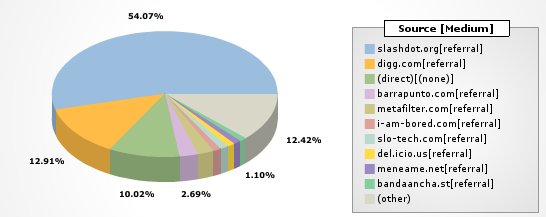 | |
| Slashdot: | 75,753 visits |
| Digg: | 18,087 visits |
| Barrapunto: | 3,767 visits |
| Metafilter: | 3,271 visits |
| I-am-bored.com: | 1,627 visits |
| Slo-Tech: | 1,589 visits |
| del.icio.us: | 1,582 visits |
| Meneame: | 1,538 visits |
Firefox & the geeks!
Almost 2/3 of the people were using the Firefox browser, who said Internet Explorer is the most popular browser? Well, not among us :)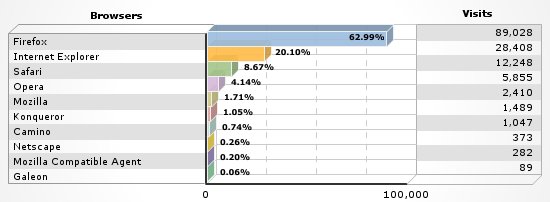 | |
| Firefox: | 63% |
| Internet Explorer: | 20% |
OSs
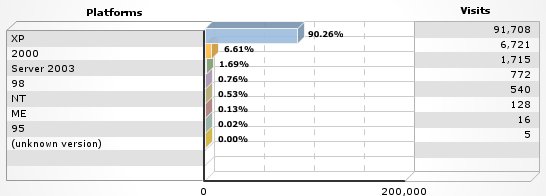
Unfortunately Linux is still not so popular as Firefox, even among the geeks.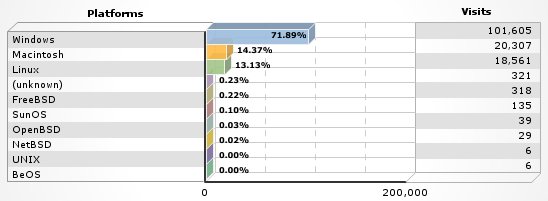 | |
| Windows: | 72% |
| Macintosh: | 14% |
| Linux: | 13% |
 | |
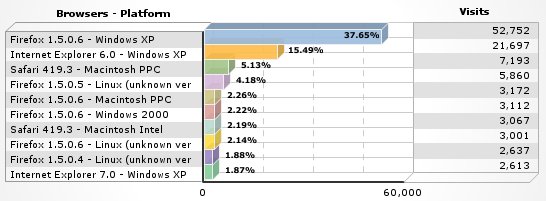
Combo: OS - Browser
 |
Screen Resolution
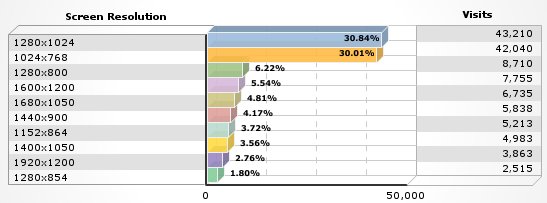 | |
| Resolution: | 1280x1024 and 1024x768 |
| Color Depth | 32 bit |
 | |
Plugins
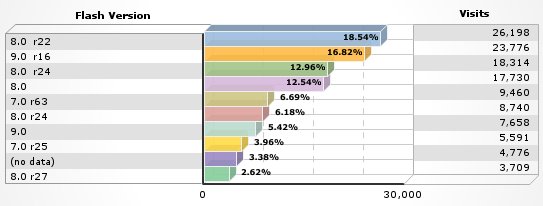 | |
| Flash: | 96,6% |
| Java: | 96% |
 | |
Connection Speed
 | |
| Dialup: | 9% |
Do geeks click on Ads?
Finally for all of you wondering what you can get (besides a burning web-server) from being slashdotted, here are the numbers. You are not going to become rich, but perhaps you have more luck than this guy.
 | |
| Page Impressions: | 154,243 |
| Clicks: | 454 |
| Dollars: | $134 |
Apple creates iTunes free TV Show page
Apple creates a new page in its iTunes Music Store with some free TV Shows listed, free to download. This offer is exclusive only in US iTunes Music Store.
Apple has been pretty generous doling out free videos on the iTunes Music Store (at least to those of us in the United States), but they made it a bit challenging to find all the sweet, sweet gratis content. Enter the new Free Downloads page (iTunes link), it is your one stop shop for all the free videos currently available for download from iTunes.
Sweet.
read more | digg story
Apple has been pretty generous doling out free videos on the iTunes Music Store (at least to those of us in the United States), but they made it a bit challenging to find all the sweet, sweet gratis content. Enter the new Free Downloads page (iTunes link), it is your one stop shop for all the free videos currently available for download from iTunes.
Sweet.
read more | digg story
Dell to recall 4 million batteries
The recall affects certain Inspiron, Latitude and Precision mobile workstation units shipped between April 2004 and July 18, 2006.
update Dell and the U.S. Consumer Product Safety Commission plan to recall 4.1 million notebook batteries on Tuesday, a company representative confirmed Monday.
The recall affects certain Inspiron, Latitude and Precision mobile workstations and XPS units shipped between April 2004 and July 18, 2006. Sony manufactured the batteries that are being recalled, the representative said. Click here to see photos of recalled batteries.
If they have one of the affected units, consumers are advised to eject the battery from the notebook after powering down and continue using the notebook with its AC power adapter, the CPSC said. Dell has so far received six reports of overheating units that caused property damage, but no injuries.
Dell has faced several issues this year related to exploding or flaming notebooks, and wants to ensure the safety of its customers, the representative said. The 4.1 million units is a subset of the 22 million units shipped during that time frame, he said. Dell said it doesn't expect the cost of the recall to materially affect its earnings. The company reports earnings for the previous quarter this Thursday.
At the moment, this looks like the largest battery recall in the history of the electronics industry, said Roger Kay, an analyst with Endpoint Technologies Associates. "The scale of it is phenomenal."
Sony will help pay the costs associated with the recall of 4.1 million batteries the company supplied to Dell, said Rick Clancy, a Sony spokesman.
"We are supporting Dell's recall," Clancy said. "There will be financial assistance and we are sharing engineering data and both doing further research." He declined to specify exactly how much assistance Sony would provide.
Customers will be able to go to a Dell Web site or to the Consumer Product Safety Commission site to determine if they need a new battery. Dell also plans to launch a toll-free number, 1-866-342-0011, for people affected by the situation, IDC analyst Richard Shim said.
"It's a huge deal," Shim said, particularly for Dell customers with employees in remote locations or traveling. "If you have people all over the field, then you're asking folks to send in the batteries and run off just AC (alternating current power) until they can get new batteries shipped out to them."
Dell had only six incidents over millions of units, Shim said, but it's "a dangerous situation."
What causes the problem?
Lithium ion batteries have two to three times the energy density of nickel-cadmium and nickel-metal hydride batteries and four times the energy density of lead-acid batteries. Higher energy density translates to longer battery life. Lithium ion batteries are used in consumer electronics and notebooks, which only require a limited amount of energy. Hybrid cars and power tools, however, generally use more traditional batteries, in part because of the risk of explosion.
Dell battery packs
The problems Dell is having stem from impurities within the anode and cathode of the battery, said Kay, who was briefed on the problems by Dell executives. Over time, those impurities, usually tiny pieces of metal, can work their way to the edge of the anode or cathode and rupture the isolator that sits between the two, he said. Once that happens, you get a short circuit and possibly a fire.
In cell phones, lithium ion batteries can overheat because of a short circuit. If the temperature rises slowly, the battery case may melt. If it rises rapidly, however, enough pressure may be generated to create a small explosion in a lithium ion battery. Consumers have suffered severe burns as a result of these failures. The chemical reaction that produces energy in a lithium ion battery is considered quite violent.
Several companies, including Valence Technology and PowerGenix, are working on safer lithium ion batteries or batteries which rely on different chemicals.
"The timing of this does buy Dell goodwill with customers and potential customers," said Sam Bhavnani, an analyst with Current Analysis. The first pictures of exploding laptops were posted in June, and the company has moved fairly quickly to investigate whether or not the problems were isolated or more widespread, he said.
Models in the hot seat
Dell plans to announce a recall of 4.1 million batteries worldwide on Tuesday. Here's a list of the affected models.
It's possible that other PC vendors are using the Sony batteries in their products, Kay said. Dell executives told Kay that the company was one of the first to begin using this type of battery, and that they think other problems will crop up down the road for other PC companies.
But even if two companies use the same batteries, they don't necessarily design the technology that connects the battery to the notebook in the same way, Kay said. For example, Lenovo's notebooks use software that's designed to shut down the battery if it notices a problem and they charge the batteries more slowly than others in the industry, a company representative said. A Dell representative was unable to comment on the specifc technology it uses to enclose its batteries.
Sony's lithium ion cells can be found in the battery packs used by other manufacturers, but at this point Sony and those manufacturers have not seen the same level of problems that affected the Dell notebooks with Sony's technology, Clancy said. "We are in close communication with our customers, and as appropriate we will work with them and the CPSC if needed," he said.
A Lenovo representative said the company has not seen an unusual pattern of problems with its notebook batteries, although no PC company is immune to battery issues from time to time. Lynn Fox, an Apple Computer spokeswoman, said, "We are currently investigating whether batteries that have been supplied to Apple for our current and previous notebook lines meet our high standards for battery safety and performance." Representatives for Hewlett-Packard and Gateway were not immediately available to comment.
CNET News.com's Stephen Shankland contributed to this report.
read more | digg story
update Dell and the U.S. Consumer Product Safety Commission plan to recall 4.1 million notebook batteries on Tuesday, a company representative confirmed Monday.
The recall affects certain Inspiron, Latitude and Precision mobile workstations and XPS units shipped between April 2004 and July 18, 2006. Sony manufactured the batteries that are being recalled, the representative said. Click here to see photos of recalled batteries.
If they have one of the affected units, consumers are advised to eject the battery from the notebook after powering down and continue using the notebook with its AC power adapter, the CPSC said. Dell has so far received six reports of overheating units that caused property damage, but no injuries.
Dell has faced several issues this year related to exploding or flaming notebooks, and wants to ensure the safety of its customers, the representative said. The 4.1 million units is a subset of the 22 million units shipped during that time frame, he said. Dell said it doesn't expect the cost of the recall to materially affect its earnings. The company reports earnings for the previous quarter this Thursday.
At the moment, this looks like the largest battery recall in the history of the electronics industry, said Roger Kay, an analyst with Endpoint Technologies Associates. "The scale of it is phenomenal."
Sony will help pay the costs associated with the recall of 4.1 million batteries the company supplied to Dell, said Rick Clancy, a Sony spokesman.
"We are supporting Dell's recall," Clancy said. "There will be financial assistance and we are sharing engineering data and both doing further research." He declined to specify exactly how much assistance Sony would provide.
Customers will be able to go to a Dell Web site or to the Consumer Product Safety Commission site to determine if they need a new battery. Dell also plans to launch a toll-free number, 1-866-342-0011, for people affected by the situation, IDC analyst Richard Shim said.
"It's a huge deal," Shim said, particularly for Dell customers with employees in remote locations or traveling. "If you have people all over the field, then you're asking folks to send in the batteries and run off just AC (alternating current power) until they can get new batteries shipped out to them."
Dell had only six incidents over millions of units, Shim said, but it's "a dangerous situation."
What causes the problem?
Lithium ion batteries have two to three times the energy density of nickel-cadmium and nickel-metal hydride batteries and four times the energy density of lead-acid batteries. Higher energy density translates to longer battery life. Lithium ion batteries are used in consumer electronics and notebooks, which only require a limited amount of energy. Hybrid cars and power tools, however, generally use more traditional batteries, in part because of the risk of explosion.
Dell battery packs
The problems Dell is having stem from impurities within the anode and cathode of the battery, said Kay, who was briefed on the problems by Dell executives. Over time, those impurities, usually tiny pieces of metal, can work their way to the edge of the anode or cathode and rupture the isolator that sits between the two, he said. Once that happens, you get a short circuit and possibly a fire.
In cell phones, lithium ion batteries can overheat because of a short circuit. If the temperature rises slowly, the battery case may melt. If it rises rapidly, however, enough pressure may be generated to create a small explosion in a lithium ion battery. Consumers have suffered severe burns as a result of these failures. The chemical reaction that produces energy in a lithium ion battery is considered quite violent.
Several companies, including Valence Technology and PowerGenix, are working on safer lithium ion batteries or batteries which rely on different chemicals.
"The timing of this does buy Dell goodwill with customers and potential customers," said Sam Bhavnani, an analyst with Current Analysis. The first pictures of exploding laptops were posted in June, and the company has moved fairly quickly to investigate whether or not the problems were isolated or more widespread, he said.
Models in the hot seat
Dell plans to announce a recall of 4.1 million batteries worldwide on Tuesday. Here's a list of the affected models.
It's possible that other PC vendors are using the Sony batteries in their products, Kay said. Dell executives told Kay that the company was one of the first to begin using this type of battery, and that they think other problems will crop up down the road for other PC companies.
But even if two companies use the same batteries, they don't necessarily design the technology that connects the battery to the notebook in the same way, Kay said. For example, Lenovo's notebooks use software that's designed to shut down the battery if it notices a problem and they charge the batteries more slowly than others in the industry, a company representative said. A Dell representative was unable to comment on the specifc technology it uses to enclose its batteries.
Sony's lithium ion cells can be found in the battery packs used by other manufacturers, but at this point Sony and those manufacturers have not seen the same level of problems that affected the Dell notebooks with Sony's technology, Clancy said. "We are in close communication with our customers, and as appropriate we will work with them and the CPSC if needed," he said.
A Lenovo representative said the company has not seen an unusual pattern of problems with its notebook batteries, although no PC company is immune to battery issues from time to time. Lynn Fox, an Apple Computer spokeswoman, said, "We are currently investigating whether batteries that have been supplied to Apple for our current and previous notebook lines meet our high standards for battery safety and performance." Representatives for Hewlett-Packard and Gateway were not immediately available to comment.
CNET News.com's Stephen Shankland contributed to this report.
read more | digg story
Digg Adds Video Thumbnails
Starting today, all newly submitted videos from YouTube and Google will include static thumbnail previews. Support for Yahoo! videos is coming soon.
Starting today, all newly submitted videos from YouTube and Google will include static thumbnail previews. Support for Yahoo! videos is coming soon.
If you're a video hosting provider and would like digg to include thumbnail support for your videos, email us at support at digg.com, and we'll do our best to add you.
Enjoy,
Kevin
posted by Kevin Rose at 2:21 PM
read more | digg story
Starting today, all newly submitted videos from YouTube and Google will include static thumbnail previews. Support for Yahoo! videos is coming soon.
If you're a video hosting provider and would like digg to include thumbnail support for your videos, email us at support at digg.com, and we'll do our best to add you.
Enjoy,
Kevin
posted by Kevin Rose at 2:21 PM
read more | digg story
Subscribe to:
Posts (Atom)